


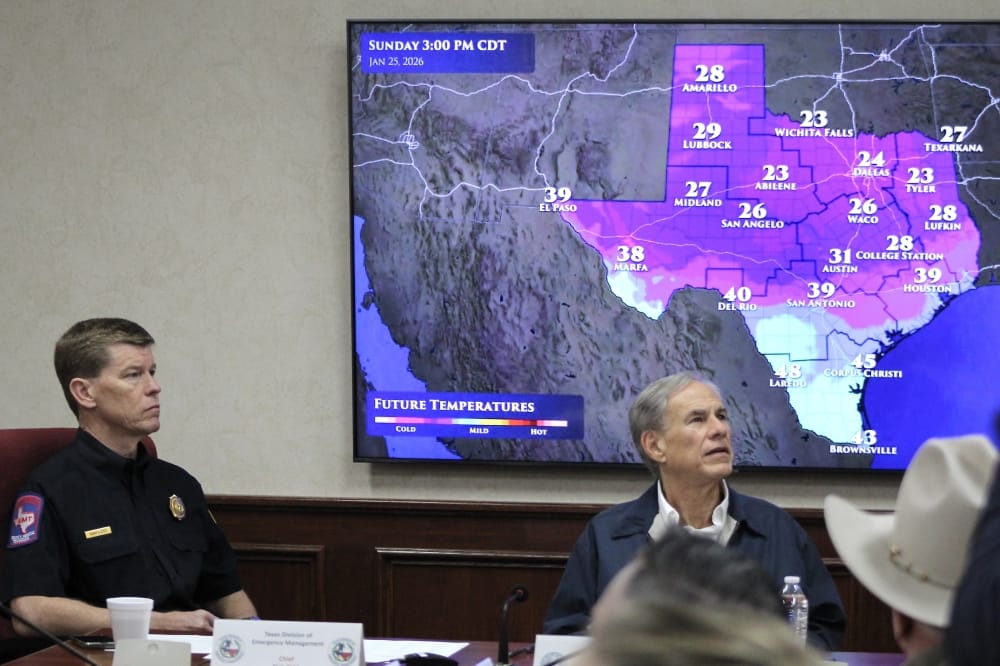
A far-reaching winter storm is expected to bring below-freezing temperatures, wintry precipitation and “dangerous ice” to Texas beginning Jan. 23, according to the National Weather Service. As residents brace for days of potentially hazardous conditions, state leaders said Jan. 22 that the Texas power grid “has never been stronger” and will withstand the storm.
The big picture
Nearly five years earlier, Winter Storm Uri blanketed Texas, devastating a power grid that was unprepared for the historic February 2021 storm. Nearly 250 people died during prolonged power outages across the state, Community Impact reported.
State officials said Jan. 22 that they are prepared for the dayslong storm and will ensure issues from 2021 do not occur this year.
“The power grid system we have today is completely different than the power grid system we had back then,” Gov. Greg Abbott said during a Jan. 22 news conference in Austin. “We have abundant power [and] the reliability of it has never been better.”
Abbott issued a disaster declaration for 134 of Texas’ 254 counties, telling reporters that the northern two-thirds of the state—from San Antonio to the Panhandle—will be impacted by the storm. The Dallas-Fort Worth area may be the hardest-hit, officials said, with Community Impact reporting that sleet and below-zero wind chills will reach the region as soon as Jan. 23.
“This is a severe winter storm that will impact most of the state of Texas,” Abbott said. “The severity of it is not quite as great, and the size of it is not quite as great as Winter Storm Uri. That said, people would be making a mistake if they don’t take it serious.”
Officials said they do not expect a repeat of the widespread power outages that occurred in 2021, emphasizing that changes have been made in recent years to harden the grid against extreme weather and secure backup power supplies. Some Texans could see “local, isolated” outages due to fallen tree branches or ice on power lines, Abbott said.
What’s happening
Local and state agencies are preparing for the freeze by treating roadways, setting up warming centers, monitoring water supplies and making additional power supplies available.
Texas Department of Transportation crews began treating roads early in the week to prevent ice from accumulating, with falling temperatures and wintry precipitation—including sleet and freezing rain—expected in parts of the state Jan. 23 through the weekend. TxDOT will be at “peak operations” in the coming days, with approximately 5,000 personnel operating hundreds of vehicles and equipment across Texas, Executive Director Marc Williams said.
Williams encouraged Texans to avoid driving during the winter storm if they can help it, noting that “any amount of ice [on roadways] is a dangerous amount of ice.”
“If travel is necessary, drivers should expect dangerous conditions,” Williams said Jan. 22. “We ask drivers to slow down, increase following distance and brake slowly. Very importantly, because of the ice, be aware of falling limbs, downed limbs and [downed] power lines.”
If Texans need to drive over the weekend, officials encouraged them to:
- Visit drivetexas.org for information about road conditions.
- Stock vehicles with food, water, blankets and safety equipment.
- Fill vehicles with fuel and be prepared for weather-related traffic delays.
Crews from the Texas Department of Safety and the Texas National Guard will be on the roads helping stranded motorists and responding to crashes, officials said. State agencies will also deliver food and water to those in need and help people get to warming centers.
Over 280 warming centers will be open across Texas during the winter storm, according to Nim Kidd, who leads the Texas Division of Emergency Management. Texans can find information about warming centers in their communities here or by calling 211.
“The goal is to make it through with no life lost,” Abbott said Jan. 22.
More details
State leaders expressed confidence Jan. 22 that the Texas power grid, operated by the Electric Reliability Council of Texas, was better prepared for this weekend’s storm than it was in February 2021. At the time, many transmission and generation facilities shut down due to below-freezing temperatures, plunging millions of Texans into darkness for days on end.
That will not happen again, officials said.
“I know that a lot of people across the state are thinking, ‘Gosh, is this going to be a catastrophic winter storm that’s going to cause us to lose power?’ The answer is, the ERCOT grid has never been stronger, [has] never been more prepared and is fully capable of handling this winter storm,” Abbott told reporters Jan. 22.
In the nearly five years since Uri, tens of thousands of megawatts of capacity have been added to the grid annually. Energy providers are also required to “weatherize” their facilities to withstand extremely hot or cold temperatures, Community Impact previously reported.
ERCOT CEO Pablo Vegas said in December that the agency has inspected over 4,000 facilities since the weatherization program launched in late 2021, with at least 450 additional inspections planned for this winter. He noted that inspectors saw “significant improvements” in power plant performance due to the program, resulting in greater grid reliability.

ERCOT issued a “weather watch” for Jan. 24-27, due to the below-freezing temperatures, ice and precipitation expected in large parts of Texas during that period. The weather watch means that electric demand will be high, and power reserves may be lower than normal; however, officials project normal grid conditions.
The weather watch does not indicate an emergency and is not a call for conservation, officials said. Vegas told reporters that he expected electric demand during the winter storm to top out around 80,000 megawatts, with “well over 90,000 megawatts of capacity expected to be able to serve that demand throughout the weekend.”
“This is a different type of weather event than Winter Storm Uri—the state was experiencing extreme cold weather leading into the storm [and] had a long, long duration of cold weather following that,” Vegas said Jan. 22. “This storm is going to be more transient, and it’s not going to be as long in duration, … so we’re not anticipating any shortfalls in power.”
Texans can sign up to receive notifications about changes in grid conditions at www.ercot.com/txans and register for ERCOT’s emergency alerts here.
Also of note
In the past few years, local utility companies across Texas have made a “historic” investment in preparedness for winter storms and other severe weather, according to Thomas Gleeson, chair of the Public Utility Commission of Texas. He pointed to recent state laws that directed utilities to trim tree branches that could fall on power lines and replace aging power poles.
In February 2023, ice buildup on power lines and tree limbs knocked out electricity for over 170,000 Austin-area households. In July 2024, over 2 million Houston-area residents lost power for days after strong winds knocked down trees and power lines during Hurricane Beryl.
Gleeson said some households may experience local power outages due to ice accumulation or downed power lines. Contact information for local utilities is available at www.puc.texas.gov/storm.
Looking back
Texans last saw a grid emergency as electric reserves dropped during a September 2023 heat wave, although agency records show that officials did not require rotating power outages as they did in February 2021.
The state grid withstood three freezes in early 2025 without ERCOT asking residents to conserve power, Community Impact previously reported.