


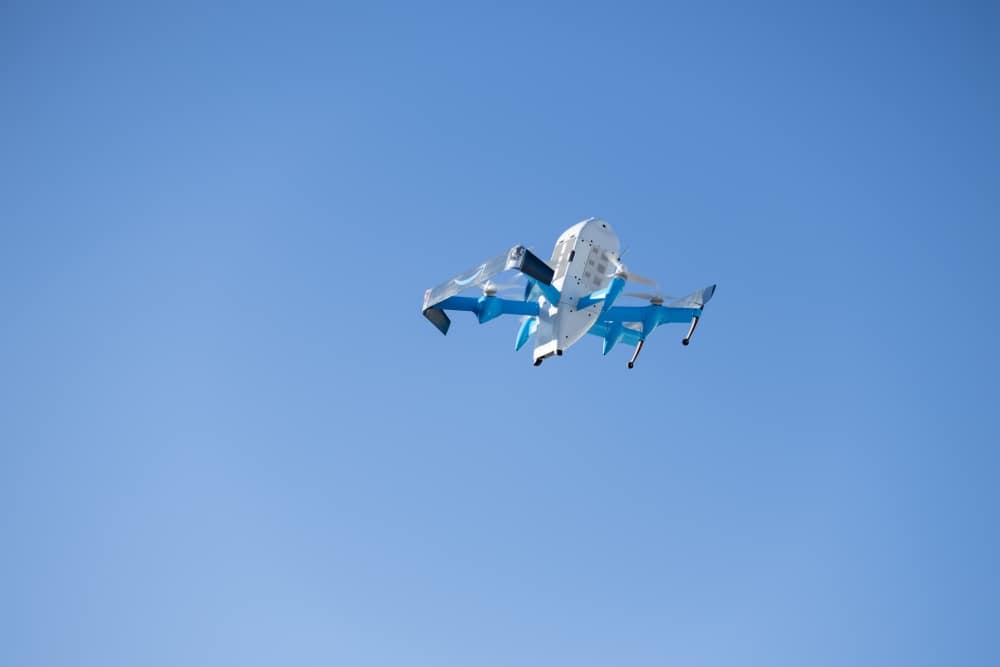
The Transportation Advocacy Group of the Houston Region, or TAG Houston, held a webinar on the future of advanced air mobility June 3.
What’s happening?
Sergio Roman, Texas Department of Transportation’s director of emerging aviation technology under the aviation division, led a “pragmatic discussion” on the future of advanced air mobility. This includes unmanned drones and electric vertical takeoff and landing—or eVTOL—aircraft, to transport people and materials.
“We’ve all seen all the marketing sketches and autonomous passengers, drones zipping over gridlocked highways and completely untethered from the realities of public policy, physical concrete or power grids,” Roman said.
In March, the Federal Aviation Administration bestowed TxDOT with Project Nexus under the integration pilot program, or eIPP.
“This isn’t going to be a theoretical study; this is going to be a dedicated, real-world operational sandbox designed to provide the FAA with empirical data that they need to draft permanent regulations around how this actually scales in the nation,” Roman said.
Explained
While Project Nexus encompasses Texas, Oklahoma, Louisiana and the Choctaw Nation, Roman said Houston will make its role vital in this undertaking as an immense industrial coastal corridor.
TxDOT’s current planning efforts involve identifying aerial pathways along state-owned highways, mapping existing grid feeds, creating the first siting and design manual for municipal adoption and incorporating air transit into regional long-range transportation plans.
TxDOT has partnered with several aircraft developers like Archer Aviation, Beta Technologies, Joby Aviation and Wisk to obtain their final aircraft-type certifications.
Diving in deeper
Roman broke down Project Nexus into crawl, walk and run strategies, with each one projected to last no more than one year.
Phase 1, or the crawl strategy, will involve testing available technology and infrastructure by existing aircraft and helicopters, identifying airport locations, examining cybersecurity and gathering data for the FAA.
Phase 2, or the walk strategy, means regional integration will take place across the Texas Triangle in Houston, San Antonio, Dallas-Fort Worth and Austin; medical and emergency response partners will be initiated; and pilot and mechanic certifications will be monitored along with workload standards/conditions.
Phase 3, or the run strategy, will begin with scaling the multistate network, analyzing grid capacity and charging capabilities, in addition to refining stakeholder coordination.
At that point, semiautonomous and autonomous aircraft will be expected to perform certain tasks; passengers can potentially use aerial ride services; and universities and trade schools will have the curriculum to populate the workforce necessary to support these endeavors.
On the horizon
Roman said when it comes to public policy, municipal building and fire codes must be modernized, land-use zoning should be standardized, and it’s best to streamline the municipal permitting pipeline for utility interconnections.
“If we can coordinate those kinds of local policy elements with the data and the operational validation that’s gonna be coming from Project Nexus, then we will establish the national blueprint, and potentially even the global blueprint, for how next-generation aviation is integrated,” Roman said.
“In a perfect world,” Roman believes Phase 3 would begin in August or September of 2028.