


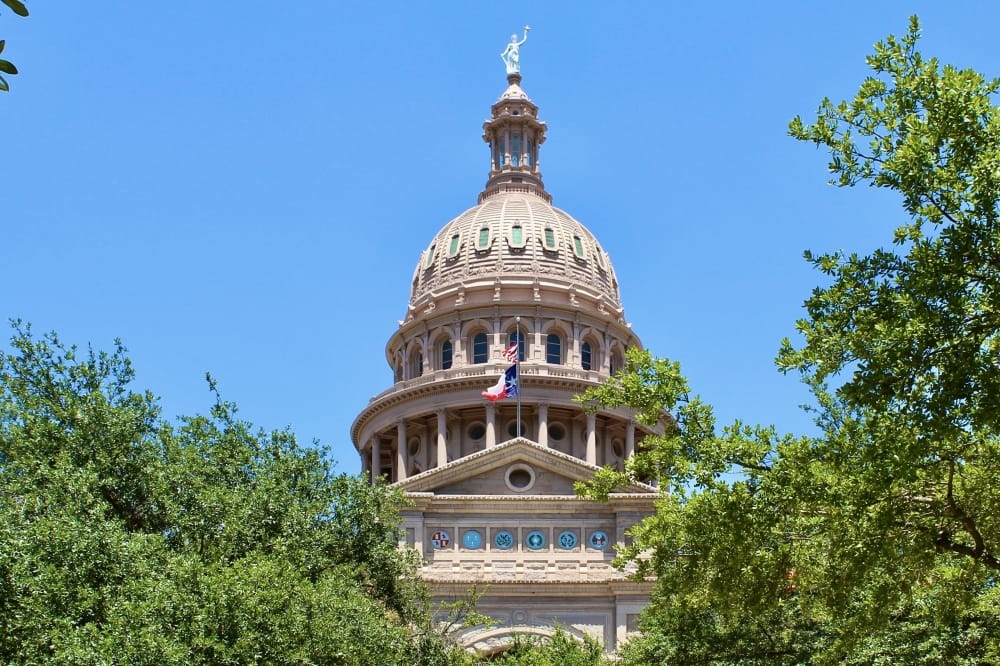
In the nine months until Texas’ 90th legislative session begins in January, state lawmakers are expected to hold information-gathering hearings on hundreds of topics that will lay the groundwork for next year’s policymaking.
This week, the leaders of the Texas House and Senate each released lists of subjects for legislators to look into through the coming months, from studies on data centers and local tax spending to potential government fraud and educator misconduct.
During a March 27 legislative summit in New Braunfels, four longtime lawmakers shared some of their top priorities for the next legislative session. State Reps. Todd Hunter, R-Corpus Christi, and Philip Cortez, D-San Antonio, will each appear on the midterm election ballot in November, while the seats held by Sens. Juan Hinojosa, D-McAllen, and Donna Campbell, R-New Braunfels, are not up for election this year.
“The vast majority of issues we deal with are nonpartisan issues,” Hinojosa said March 27. “We deal with priorities our families have: economy, health care, education, security, [workforce] training. … The reality is, our priorities are priorities that you define for us every session.”
What you need to know
During an hourlong panel discussion, the legislators said they were focused on topics such as water preservation, state education funding and the effects of data centers.
Last year, state lawmakers set aside $2.5 billion for local water infrastructure projects and created a plan to spend an additional $20 billion on water projects over the next two decades, which was later approved by voters. During the March 27 event, lawmakers said the work is not done.
“We are really focused on water,” Hinojosa said. “You will see some more how to address this issue, not only conserve water, but also how to increase our water sources.”
Hunter, who lives in Corpus Christi, was asked if the legislature would take action in his hometown, which is experiencing a severe drought that officials say could lead to water shortages. Gov. Greg Abbott has warned of state intervention if local officials do not find ways to boost water supplies.
“My hope is you’ll see a state effort and a federal effort,” Hunter said. “And even though you hear about turbulence in local government, I believe that everybody wants water resolved. The bottom line is to get our hands around it in my area, before the legislature [meets].”
Lawmakers also said they plan to study data center operations and how the large facilities impact local water supplies. The legislature will work with local officials to determine how much data center regulation should happen locally and when the state should step in, they said.
“There’s no denying that data centers have really created a big problem for local communities—they’re using enormous amounts of water, enormous amounts of electricity,” Hinojosa said.
Cortez said state leaders need to collaborate with local water boards to ensure enough water is available before a developer begins building a data center in a community. He also suggested using recycled water, “or water that is not straight out of aquifers,” for data centers.
Campbell agreed, adding that “if [a community] has a data center coming in, we’ve got to make sure that our engineers can assure us that we have the water going forward for at least 20 years.”
“Does the state need to be involved? Yes,” Hunter said. “Does local government need to have a say? Yes. But we’ve also got to remember, so does the private taxpayer. So we need to get a combination of all three.”
More details
Campbell, who was appointed this week to chair the Senate Education Committee, said lawmakers have work to do to “ensure a smooth transition” as students enroll in the first year of Texas’ new education savings account program.
The legislature created the $1 billion program last year, giving participating families access to state funds to send their children to private school or homeschool them. Between 90,000 and 100,000 students are slated to be accepted into the program for the 2026-27 school year, with the state comptroller’s office announcing March 25 that over 250,000 students had applied. Applications are set to close March 31 and the state will use a need- and income-based lottery to determine who is accepted, Community Impact reported.
“We’ve got to make sure the system is fluid, easy to use and that we understand how [the comptroller’s] going to be delivering the money,” Campbell said. “There’s likely to be tweaks that we can make to that in the upcoming session.”
The size of the program’s waitlist could shape how much state lawmakers choose to spend on education savings accounts next year and in future legislative sessions. The nonpartisan Texas Legislative Budget Board previously projected that due to demand, lawmakers would expand the program to $3.3 billion by 2028 and $4.8 billion by 2030.
Cortez, who said he attended San Antonio private schools as a child, encouraged his colleagues to consider policies to help students from low-income households access private education.
“Right now, the program is [$10,474 per student], and some of these schools charge more than that for tuition—$15,000-$17,000 a year,” Cortez said March 27. “How can we ensure that those families, the lower-income families, specifically, have access to some of these schools?”
During the 2023-24 academic year, the average cost of Texas private school tuition was $10,965 for kindergarten through eighth-grade students and $14,986 for high school students, according to the Texas Private Schools Association. Of the first 224,000 applicants to the education savings account program, about 72% were from families deemed low- or middle-income, per state data released March 23.
Lawmakers said March 27 that they also planned to study home insurance costs, the state’s role in border security initiatives, and how local government entities use property tax revenue.
One more thing
During an earlier panel at the March 27 summit, local leaders and policy experts discussed what needs to be done to support Texas’ growing population. The panelists said they hoped to see lawmakers prioritize infrastructure designed to support the “Texas triangle,” which refers to communities in and around the state’s three largest metropolitan areas: Dallas-Fort Worth, Houston and Austin-San Antonio.
Henry Cisneros, a former U.S. Secretary of Housing and Urban Development, said about 66% of Texas’ 31.7 million residents live in the 35 counties that make up the Texas triangle, with those residents producing 77% of the state’s gross domestic product.
“The truth of the matter is, the GDP of Texas is no longer produced in wide open spaces, oil and gas and ranches and cattle,” Cisneros said March 27. “It’s the Port of Houston, it’s the DFW airport. … It’s Austin and the University of Texas and the Technology Center San Antonio; it’s cybersecurity and biomedical. That’s the new economy of Texas.”
Making it easier for people to get between Texas’ largest cities and counties should be a top priority for state and local leaders, Fort Worth Mayor Mattie Parker said.
“For me in Fort Worth, if I’m going to drive north to Collin County, that’s an over one-hour drive,” she said. “Mobility solutions for Texans are still something that all of us are working on—what does real mobility, whether it’s transit or highway infrastructure, really look like, … because congestion is oftentimes one of the worst things you can do for economic development in a community.”