


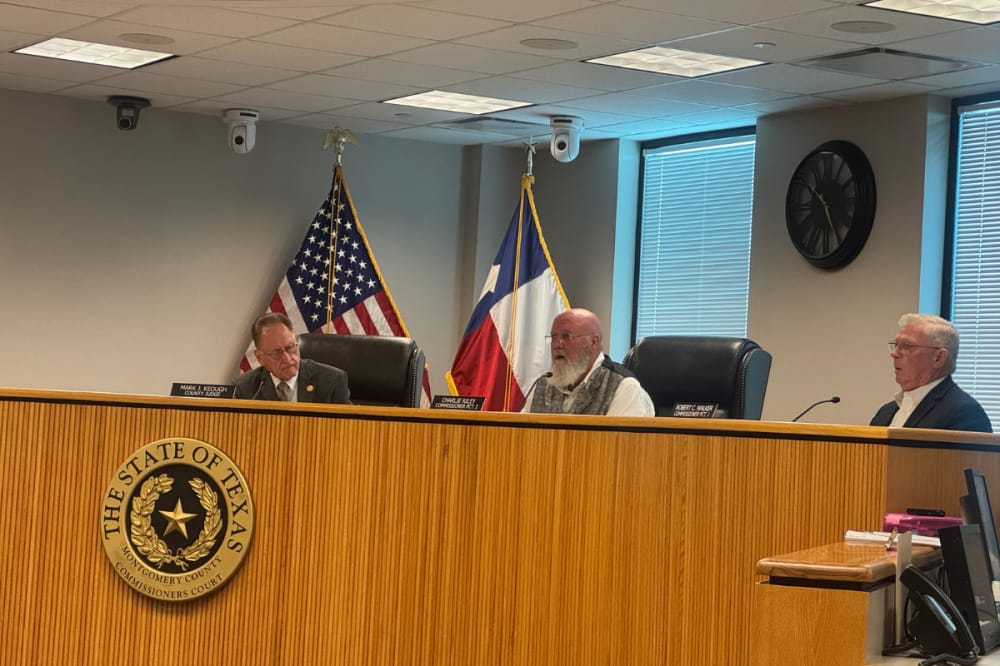
During a June 11 meeting, Montgomery County commissioners voted 4-1 to create four new courts to help handle increasing caseloads. Precinct 4 Commissioner Matt Gray was the opposing vote. The initial proposal to create nine new courts was met with discussion about location and funding challenges, so commissioners decided to reduce the number.
The discussion
Two district court judges, 284th District Judge Kristin Bays and 418th District Judge Tracy Gilbert, presented data to support the request for a resolution for the new courts from the state’s Office of Court Administration. Bays said many more courts are needed to meet the increase in case filings. A total of 40,794 cases were filed in 2025 in Montgomery County, but that is projected to increase to 43,299 this year, according to data from the Montgomery County OCA director. In January, Community Impact previously reported judges had warned commissioners for months that the courthouse was facing capacity issues.
“We’ve been trying to bring this issue to y’all’s attention for a prolonged period of time in anticipation of this purposely delaying of the request for a clump of courts, because it’s been recommended by the state for years,” Gilbert said.
According to the presentation, the Board of Judges’ unanimous request called for:
- Three new district civil courts
- Two new district family courts
- One new district criminal court
- Two new county courts at law with felony jurisdiction
- One new probate court
“We can’t keep not asking what the judiciary needs because we don’t have a place to put them,” Bays said. “That’s the problem that we face, and we want to get in front of this Legislature because if we have to wait until 2029 Legislature … we’re talking about courts that won’t come online until 2031. Think about how bad things we’re going to get your brand new courthouse that’s going to be crawling with people who are demanding justice and not able to get it.”
However, Precinct 1 Commissioner Robert Walker said a decision on the resolution for nine courts was a difficult request without a location set in place.
“If we were to pass this today, y’all put more pressure on us as commissioners to try to figure out where to put these courts … the burden is money and trying to create something in a faster motion to grab the time frame,” Walker said.
How it works
Bays and Gilbert broke down the numbers from OCA for commissioners. The OCA, headquartered in Austin, collects data and tells the county what it needs for a court to properly function. Once the data is obtained, the judges present it to commissioners to obtain a resolution to create new courts. The OCA then creates a map to outline court needs.
States differ in their processes, but if a judge is handling a workload equivalent to that of 1.15 full-time employees, it’s deemed acceptable, Bays said. However, anything over that number warrants creation of a new court, Bays said.
What they’re saying
Commissioners and judges debated the pros of a plan for new courts. Gray said he had concerns on the timing and location for the new courts. Bays said once a decision was made on the approved number of courts in the resolution, courts would go online Jan. 1, 2029.
Precinct 2 Commissioner Charlie Riley said he doesn’t think commissioners have to agree with the state’s recommendation for nine courts, but he said something needs to be done.
“I think the longer we put this off, the worse it’s going to get; it’s just like the courthouse and the jail that we’ve put off and put off and put off. Now, here we are, trying to figure out how we’re going to pay for all this,” Riley said.
In explaining why he was against the resolution, Gray said even though county officials want a new courthouse, and to meet the growing demand, he doesn’t want to rush a decision.
“Are we going to try to bring the new courts on before we even have the space to do it? I’m looking forward to having the meeting with the discussions with the architects to make sure we’re not in the jam in 10 years or five years from now,” Gray said.
What happens next
After an executive session was held, commissioners decided to create a new resolution outlining how many courts were approved. The new, signed resolution states support for the following four courts in the 90th Texas Legislature:
- One new district court (preference to civil cases)
- One new district court (preference to family cases)
- One new county court at law
- One new probate court
“If you do the caseload five years from now, you’re going to have an increase of probably somewhere in the neighborhood of 25,000 cases. Based on what they’re doing now [with] 15 courts [and] what we have set up, it’s not sustainable. We have to stage it out, and I think that’s what we’re doing by establishing four [courts] assuming that the state even agrees to it,” Precinct 3 Commissioner Ritch Wheeler said.