


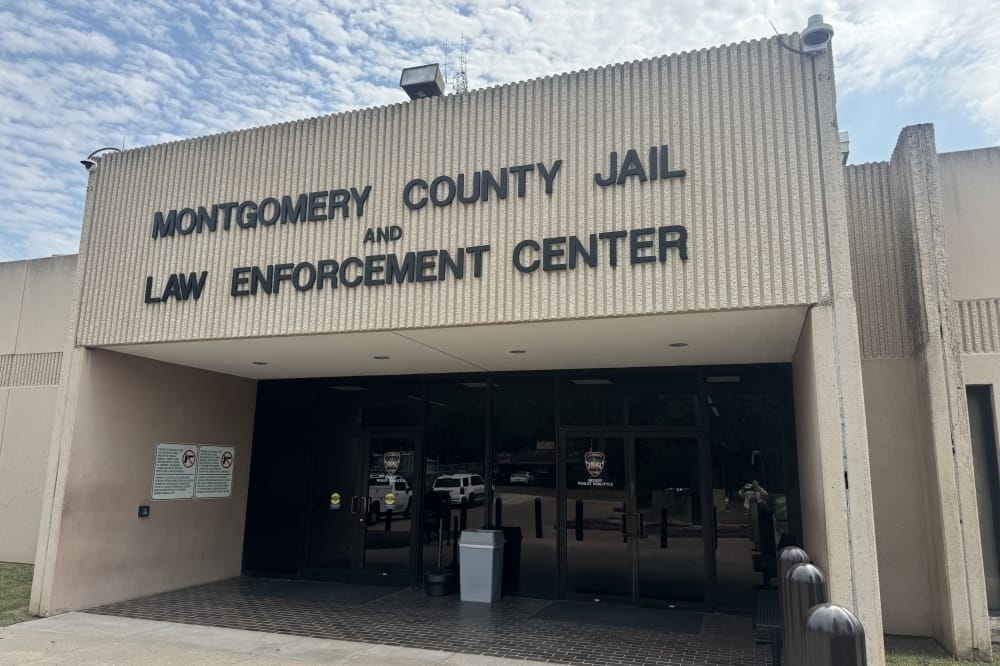
Montgomery County Sheriff Wesley Doolittle said the county jail has returned to compliance after previously failing state inspections, but the facility remains a major point of focus as officials continue weighing what comes next for the aging jail.
Doolittle gave county commissioners an overview of the Montgomery County Sheriff’s Office annual report during the May 7 Commissioners Court meeting. The agenda also included a separate item to “consider, discuss, and take appropriate action regarding County Jail and related matters,” but that item was deferred during the meeting.
The gist
During the presentation, Doolittle said the sheriff’s office is responsible for 1,317 inmates “24 hours a day, seven days a week,” while also covering a county spanning 1,077 square miles and serving more than 800,000 residents, based on the office’s unofficial population count.
“The jail has been a big talk,” Doolittle said. “When I came into office, this jail was failing inspections, failing standards, had previously failed twice, was not in compliance, was in a remedial state and we brought that up to compliance.”
Doolittle credited Chief Eric Hensley, Chief Kevin Richards and the court’s support for adding another captain at the jail to help keep the facility in compliance.
What’s changed
Doolittle said the sheriff’s office has reorganized jail, inmate transport and courthouse security operations under one justice bureau, led by Hensley. He said it has helped the office operate more efficiently.
“When the left hand doesn’t know what the right hand is doing, or when you have divisions that are fragmented and don’t communicate as well, it’s harder to get them to work together,” Doolittle said.
He also pointed to the office’s shift from a private medical contractor to a partnership with Texas Tech University. Doolittle said the partnership has helped the county “take better care” of people in custody.
The sheriff’s office is also working with Texas A&M University for psychological services and Tri-County Behavioral Healthcare, Doolittle said. He estimated that about 100 inmates in the Montgomery County Jail are not competent to stand trial.
“I think it’s important that we move these people through this criminal justice process as quickly as we can, to uphold their constitutional rights and to be more efficient in our courts and our operations,” Doolittle said.
Diving in deeper
Doolittle also highlighted the jail’s participation in the 287(g) federal program, which allows local law enforcement to work with federal immigration officials. He said the sheriff’s office had 88 deportation holds in 2023, one in 2024 and 991 last year.
The sheriff also said the county is preparing to use rapid DNA technology at the jail. Doolittle said Montgomery County was selected for the system through its relationship with the Texas Department of Public Safety and the crime lab, and the jail has already made the necessary equipment and facility changes.
Once an agreement comes through the court, Doolittle said the system would allow DNA samples from eligible people booked into the jail to be checked against unsolved crimes in CODIS, the Combined DNA Index System, within about two hours. He said the process previously could take months.
How we got here
The update comes about a month after commissioners reviewed long-term jail options, as previously reported by Community Impact. During the April discussion, consultants told the court the county’s jail planning showed a need for about 2,352 beds by 2040. Following that discussion, commissioners moved with contingencies to look into building a new jail.
At that meeting, officials said the existing jail was originally built for about 380 inmates and now has 1,317 rated beds, including a 64-bed variance. The county also reviewed cost estimates ranging from about $705.3 million to expand the current jail to about $976.8 million for a new facility, as previously reported.
Stay tuned
No formal action was taken on the deferred jail item May 7. However, Doolittle said the sheriff’s office has “roadmaps” for future needs and plans to keep commissioners updated on what comes next for the department and the jail.