


Montgomery’s Historic Season of Terror
“The Yellow Fever Epidemic of 1867 was one of the most catastrophic events in the history of the Lone Star State (easttexashistory.org).” It devastated families and communities and rewrote Texas history forever. The yellow fever hit so hard and fast that cemeteries are full of victims with graves marked by a few rocks, lilies, or nothing at all. This is exactly what you’ll find in the Old Montgomery Cemetery. Montgomery was one of the areas that was hit very hard. The “season of terror” as some called it, was an event that, for most, would only be a horror of imagination, but for many communities in 1867, the yellow fever epidemic was the shocking reality.
“Yellow fever is a mosquito-borne viral disease, primarily transmitted by day-biting mosquitoes (who.int).” “The disease is thought to have originated in the jungles of Africa, having been carried over the seas by ship in the Atlantic slave trade, though it was doubtless transported in ships carrying non-human cargo, as well. Having been introduced into such coastal regions as Cuba, New Orleans, and Memphis in this way, it was then repeatedly carried into Galveston Island aboard ships from fever-prone areas (easttexas history.org).” “When someone contracted a mild form, it was a flu-like disease that lasted approximately a week. Symptoms included fever, chills, muscle aches, and nausea. For many others, yellow fever symptoms quickly progress to a dangerously high fever, jaundice, signifying liver failure, and systemic breakdown of the clotting system, causing the body to hemorrhage from the gums, nose, and stomach lining. The dark, digestive blood regurgitated by yellow fever victims was commonly called ‘black vomit.’ Kidney failure is followed by death within one or two days (tshaonline.org).” “During the 1867 yellow fever outbreak, there were no effective cures, as the mosquito-borne transmission was unknown. Attempted treatments included dangerous bloodletting, blistering, vomiting, and heavy use of mercury (calomel) to induce purging. Other efforts included chamomile tea, mustard plasters, and brandy/lemon sponges, while some used traditional herbal medicine (AI overview).”
The outbreak of this, seemingly unstoppable disease, started in Indianola, Texas in June 1867. “The virus did not finally stop until later that year, in November, with the first frost of the year. By then, approximately 4,000 Texans had died, which suggests that close to 40,000 had become infected. The disease would dramatically change many of these towns, as industries were slow to recover, prominent families never returned, and colleges began to think about relocating (easttexashistory.org).” My hometown, Montgomery, Texas, was in the region of east Texas that was hit very hard. Specific records are hard to come by on how many died during the outbreaks in Montgomery, but we do know that the Old Montgomery Cemetery filled up very quickly with yellow fever victims. The nearby town of Navasota had a population of about 3000 people at the time. The first death known to be from yellow fever in Navasota happened on August 5, 1867. Yellow Fever raged on until there was a “Killing Frost” in late November 1867. When it was over, the town starting with a population of 3000, between the 176 deaths and residence fleeing, had been reduced to 400.
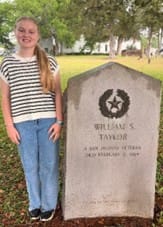
With all the deaths that were taking place statewide, there were many important political and military figures losing their lives as well…one of these being our very own, William Stanhope Taylor, Texas revolutionary war veteran and planter. “Taylor was born in Canton, Stark County, Ohio, in 1819. He moved with family to Tennessee in the 1820s. In 1831, Taylor’s father got a Mexican land grant in present-day Fayette County. After the death of his father to yellow fever in August 1833, Taylor returned to Texas to take care of his father’s estate. On October 17th, 1835, he enlisted in the revolutionary army and served with Capt. John M. Bradley at the siege of Bexar, including the grass fight. He was then discharged on December 23, 1835, just to re-enlist on March 12, 1836, and serve under Capt. William Ware and Capt. William Smith. He served with Captain Smith’s Company J in the calvary charge on the Mexican left flank, followed by the pursuit of General Santa Anna and his calvary towards Vincent Bridge. Taylor was then granted 1,476 acres of land in Montgomery County, in 1838, for his military services. He then married Agnes Elizabeth Garrett on June 7, 1838, in Montgomery County, Texas, and they had eleven children(tsaonline.org).” “A lengthy account of the San Jacinto campaign and the capture of Santa Anna were written by Taylor and were published in the Texas Almanac of 1868 (visitmontgomerytexas.com).” “Not only did he nominate Sam Houston for president of the United States as ‘the people’s candidates,’ but he also was asked to serve as a Vice President of the Republic of Texas, under President Sam Houston (tshaonline.org).” “Taylor was a member of the Baptist church, the Masonic Lodge and served as county commissioner of Montgomery County.
‘After serving his country, his state, and his community well, for more than 30 years of his adult life, William Stanhope Taylor died on February 2, 1869. Yellow fever accomplished what Santa Anna, and the rigors of the frontier were unable to do (visitmontgomerytexas.com).’” He is buried with Masonic Honors at the Old Montgomery Cemetery. Interesting fact…Taylor’s headstone is the only one facing Hwy 105. He left behind a legacy and continues his mark on this community today with descendants living in the area (Pastor Rob Matchett-Adult ministries Lone Star Cowboy Church). The Garrett house, or Rabon Fullen home, was originally built for Vol Rabon and his wife. Vol Rabon’s maternal grandfather was William Stanhope Taylor.
I had the honor of going to visit his grave and the Old Montgomery Cemetery with my ELA teacher Mrs. Dianne Lane and her husband Buddy Lane. I don’t think it was by coincidence that it was a rainy and dreary day when we went to visit the site. The things that ran through my mind were nothing short of astonishment and sorrow. I saw graves of infants, young children, twenty-two-year-olds, seventy-year-olds, and whole families buried together; they all died within a very short time span…most in 1867. The yellow fever took such a toll on this community, that I can’t even fathom what these people went through.
The yellow fever was a deadly and horrific disease that ruined individual lives and families, without a care of who you were. It made its mark on Texas in various communities statewide. The impact it had on Montgomery alone is astonishing and heartbreaking. The little town of Montgomery and Texas are fascinating in the richness of its history that most don’t even know exists. I urge people to research the history as well as the people that came before us along with visiting sites that remain from those days. With history comes victory and development, seeing how far we’ve come from years ago to now; but it also comes with the struggle and devastation we had to get through to get to where we are now. The yellow fever epidemic was no doubt one of those devastations. Yet, with all the horror it brought, and all that it took from us, it left us with a stronger people that won’t stop persevering even when disaster comes. When you see the hardships that our ancestors went through to get to where we are now, you’ll want to keep going and keep fighting, for yourself, but also for those that came before us.
Copyright Montgomery County News.. All rights reserved.