


Article by: Dan P Edwards
Honoring
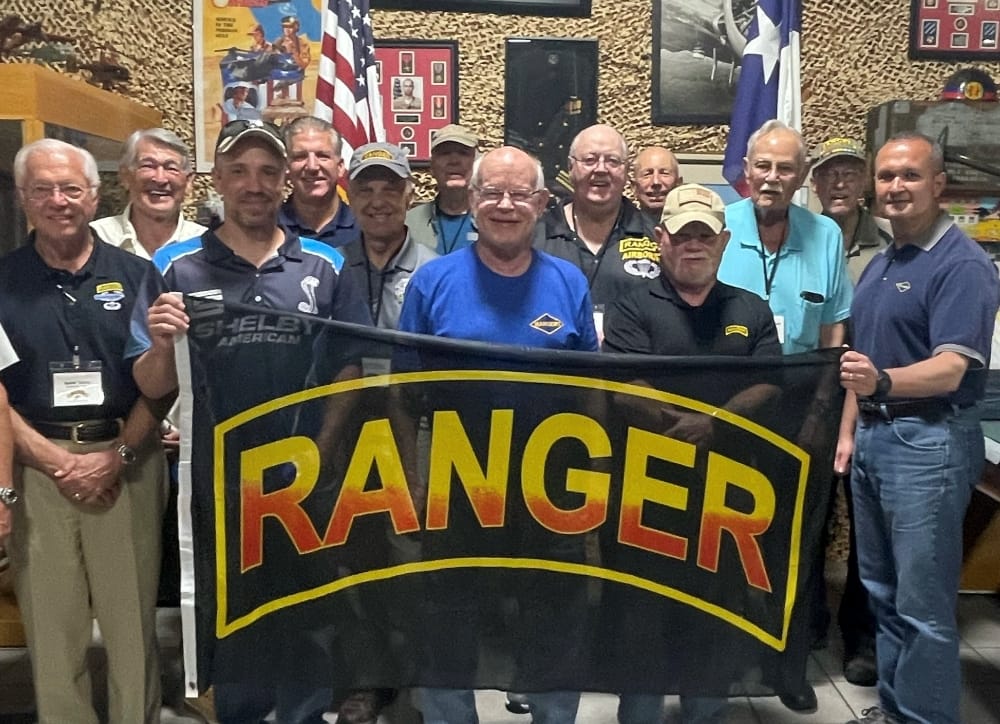
our military men and women and our veterans is truly American. I had
the humbling opportunity to meet members of the James E. Rudder Ranger
Base, right here in Conroe. This group, led by Bob Delzell, is one of
several local chapters of Ranger Bases around the U.S. From their
website “Since 1973, the U.S. Army Ranger Association, Inc. (USARA) has
been a veterans service organization dedicated to supporting active duty
and veteran U.S. Army Rangers”. The local James E. Rudder Ranger Base
meets monthly at the Honor Cafe, in Conroe, and welcomes all Rangers,
past and present, into this special membership.
While
in session, many of the brave veterans of Montgomery County that have
earned the right to be called Rangers enjoy fellowship, camaraderie,
sense of belonging, and supportive commentary to celebrate past service
to their Ranger Battalions and their lifetime sacrifice to family and
country. Ranger Units don’t organize to guard ships and installations,
they mobilize to fight. Accepting the tough assignments and engaging the
enemy in direct combat is their DNA. Celebrating their achievements in
peacetime is essential to their wellbeing. Understanding who the Rangers
are can help us honor their service.
In
the early morning hours of June 6, 1944, as Allied forces stormed the
beaches of Normandy, Brig. Gen. Norman Cota stood amid the chaos on
Omaha Beach. Machine-gun fire raked the sand, and troops lay pinned
down. Spotting a group of soldiers from the 5th Ranger Battalion, Cota
shouted the words that would echo through history: “Rangers, lead the
way!” Those words became the official motto of the U.S. Army Rangers, a
rallying cry for an elite force that has repeatedly changed the course
of battles and safeguarded American freedom from World War II to the
present day.
The
modern Rangers trace their origins to the desperate early days of World
War II. In 1942, with the U.S. Army lacking specialized commando units,
Gen. Lucian Truscott Jr. drew inspiration from Britain’s Commandos and
America’s own colonial-era Rangers—such as Robert Rogers’ famed unit
from the French and Indian War. On June 19, 1942, the 1st Ranger
Battalion was activated in Northern Ireland under Lt. Col. William O.
“Bill” Darby. Hand-picked volunteers endured grueling training modeled
on British methods, forging a force ready for lightning raids, deep
reconnaissance, and high-risk assaults.
Darby’s
Rangers first proved their mettle in North Africa during Operation
Torch in November 1942. Scaling cliffs and storming the port of Arzew,
Algeria, they captured key harbor defenses in just 15 minutes, securing
an Allied foothold with minimal losses. They spearheaded the Sicily
invasion in July 1943 and the Salerno landings in Italy that September,
clearing beaches and inland routes for larger forces. Though the 1st,
3rd, and 4th Battalions suffered devastating casualties at Anzio in
early 1944, their aggressive spirit set the standard for future
generations.
Nowhere
was that spirit more dramatically displayed than on D-Day. Lt. Col.
James E. Rudder led three companies of the 2nd Ranger Battalion up the
sheer 100-foot cliffs of Pointe du Hoc under withering German fire.
Their mission: destroy a battery of six 155mm guns threatening both
Omaha and Utah beaches. Using ropes, ladders, and sheer grit, the
Rangers reached the top, only to discover the guns had been moved.
Undeterred, they located and destroyed them inland, then held the
position for two grueling days against counterattacks until relief
arrived. Meanwhile, the 5th Rangers, alongside the 2nd, punched through
German wire on Omaha Beach after Cota’s famous order. Their actions
helped crack open the Atlantic Wall, enabling the Allied breakout that
liberated Europe. Historians credit these Ranger-led assaults with
preventing a potential disaster at Omaha and altering the trajectory of
the war in the West. Lt. Col Rudder continued on to participate in the
Battle of Hurtgen Forest and the Battle of the Bulge in 1945 and
ultimately reached the rank of Major General by his retirement in 1967.
Post war, Rudder returned to his alma mater and became Texas A&M University’s 16th president.
In
the Pacific, other Ranger units wrote equally heroic chapters.
Merrill’s Marauders—the 5307th Composite Unit (Provisional)—conducted a
grueling 1,000-mile jungle march in Burma in 1944, disrupting Japanese
supply lines and capturing the vital Myitkyina airfield. The 6th Ranger
Battalion executed a daring raid on the Cabanatuan prisoner-of-war camp
in the Philippines in January 1945, freeing more than 500 Allied
prisoners in one of the most successful rescue operations of the war.
After
World War II, the Rangers were deactivated, but the Army quickly
recognized the need for their unique skills. During the Korean War,
eight Ranger Infantry Companies (Airborne) conducted raids, ambushes,
and long-range patrols behind enemy lines. In Vietnam, 15 separate
Ranger companies—redesignated under the 75th Infantry Regiment (Ranger)
in 1969—served as Long Range Reconnaissance Patrols (LRRPs). Operating
deep in enemy territory along the Ho Chi Minh Trail, they gathered
intelligence, disrupted supply lines, and conducted ambushes that saved
countless American lives. Many of the members of the James E. Rudder
Ranger Base here in Conroe served in Vietnam, while some have served
more recently in Iraq and Afghanistan campaigns.
The
modern 75th Ranger Regiment was born in the post-Vietnam era to meet
the demands of rapid global deployment. The 1st and 2nd Battalions
reactivated in 1974, the 3rd in 1984, and the full regiment was stood up
on February 3, 1986. Today, four geographically dispersed battalions
stand ready, headquartered at Ft. Benning, Georgia, and capable of
deploying anywhere in the world within 18 hours.
Their
post-Vietnam record is one of unbroken excellence. In 1983, Rangers
from the 1st and 2nd Battalions parachuted into Grenada during Operation
Urgent Fury, seizing Point Salines Airfield and rescuing American
medical students. In 1989’s Operation Just Cause in Panama, the entire
regiment conducted simultaneous combat jumps to capture airfields and
key objectives, neutralizing dictator Manuel Noriega’s forces. During
the 1991 Gulf War and the 1993 Battle of Mogadishu in Somalia, Rangers
again demonstrated their versatility in raids and quick-reaction
missions under extreme conditions.
The
Global War on Terror has seen the Rangers at the forefront of nearly
every major operation. On October 19, 2001, the 3rd Battalion conducted a
historic combat jump into Afghanistan to seize Objective Rhino—the
first major U.S. ground operation there. In Iraq in 2003, they executed
another airborne assault on Objective Serpent and conducted countless
raids that captured or eliminated high-value targets, including senior
al-Qaeda leaders. Over two decades of continuous combat, Ranger
battalions have logged thousands of missions, often conducting more than
900 operations in a single deployment. They have disrupted insurgent
networks, rescued hostages, and operated alongside every major U.S. and
coalition force, maintaining an unprecedented operational tempo.
Today,
in 2026, the 75th Ranger Regiment remains the Army’s premier
direct-action raid force—lethal, agile, and always prepared. Whether
training for future threats or supporting ongoing global operations,
Rangers continue to live by their creed: “Rangers lead the way.” Their
legacy is not just one of battlefield victories but of sacrifice.
Countless Rangers have given their lives or borne the invisible wounds
of war so that we may live free.
In
addition to supporting their own, the USARA awards academic
scholarships for potential students and has a program that provides
direct monetary assistance to Rangers and their families experiencing
financial hardship. Assisting Rangers and their families transition
from active duty military service into civilian life is a key benefit
available to all members. Please visit their website at https://ranger.org for additional details.
The
local James E. Rudder Ranger Base sponsors a lunch meeting every 2nd
Saturday of each month at the Honor Cafe, located at 103 N. Thompson St,
Conroe, Texas. The meetings are open to all Rangers and their
spouses. The meal is free to all participants and USARA membership is
preferred but not required. Contact information and meeting dates can
be found at https://ranger.org/rudder-ranger-base
For
the families and communities of Montgomery County—home to proud
veterans, active-duty service members, and Gold Star families—this
history is personal. The Rangers remind us that ordinary Americans, when
called to extraordinary duty, can achieve the impossible through
discipline, courage, and brotherhood. As we honor their service from the
1940s to today, let us recommit to supporting our Rangers, their
families, and all who wear the uniform. Whether through community
events, veteran programs, or simple acts of gratitude, we owe them
nothing less.
Rangers
Lead the Way—yesterday, today, and always. They have changed history
time and again, and America stands stronger because of it.
Significant
portions of the historical facts about Rangers in modern warfare were
researched and drafted from internet queries, personal library, and in
some cases summarized with the assistance of AI to gain Associated Press
grammar and rhetoric standards, and then edited. Any historical
inaccuracies are the responsibility of the author.