


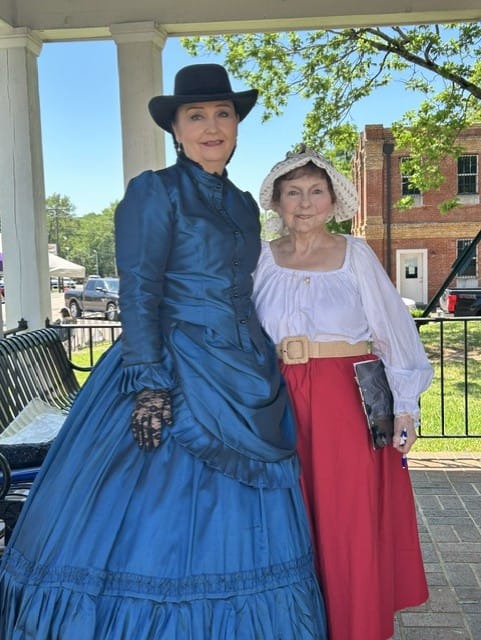
Francis Cox Henderson was born on July 21, 1820, in Philadelphia, the daughter of John and Martha Cox. Her father was a merchant and President of the Lehigh Coal and Navigation Company. He later became its plenary agent in Europe.
From an early age her father recognized that her mind was restless and hungry for knowledge. When she was only nine, he moved her and her siblings to Europe so they could receive the kind of education he believed they deserved. Some people have commented that she was destined to become one of America’s most distinguished and interesting women.
By nineteen, her life changed forever. In Paris, she met James Pinckney Henderson. At the time he was envoy of the Republic of Texas. His work carried him between the courts of France and England, and she found herself drawn to his sense of purpose and the promise of a new land.
They were married in London in Saint George’s Chapel, Hanover Square on October 30, 1839. It was a grand affair. Her trousseau was exquisite – truly worthy of royalty. Their wedding was actually attended by European royalty.
Born in Lincolnton, NC, James Pickney Henderson was a lawyer, soldier, diplomat, and statesman. He studied law at the University of North Carolina and was admitted to the bar in 1829. After moving to Mississippi, he learned of the Texas Revolution and like so many other young men, he recruited volunteers and traveled to Texas in 1836. Although major battles had already ended, he was commissioned as a brigadier general and sent back east to recruit troops for the new Republic.
James quickly became one of the most important early leaders of the Republic. He served as:
• Attorney General under President Sam Houston (1836)
• Secretary of State, succeeding Stephen F. Austin (1836)
• Minister to England and France, where he successfully negotiated recognition of Texas independence and commercial treaties (1837–1839)
• His diplomatic work was crucial—European recognition strengthened Texas’ legitimacy as an independent nation.
Soon after their wedding, they returned to America and then Texas. In June 1840, San Augustine became their home. You can imagine what an adjustment that was for Francis. From grand salons of Europe to a small frontier settlement. Shortly after their return they built a home in a grove of magnificent oak trees in the southern part of town. Their home soon became the chief center of social affairs of all East Texas. They hosted everything from small intimate teas to grand balls for some of the ablest and learned men in our Republic’s history.
James opened his law office in San Augustine, and Francis—never content to sit idle—studied law with him. She mastered the law so sufficiently that she eventually managed the practice when his duties took him away. She remained in San Augustine, continuing the work that mattered most to her: building community and strengthening the Episcopal Church across East Texas. She helped establish congregations in San Augustine, Rusk, Palestine, Nacogdoches, and Trinity, often pushing against expectations of what a woman should or should not do.
In 1855 she stood before Bishop Alonzo Potter in Philadelphia, insisting, with credentials in hand, that she be allowed to address the clergy to secure a minister for the struggling Texas parish. No woman had done such a thing before.
In 1845 after Texas became a state of the Union, James was elected the first Governor. She was so proud of him. They split their time between San Augustine and Austin. It is well documented she was a helpful companion to her husband in mentality, social ability, and spirituality.
1846 James was appointed Major General of the volunteers of the War With Mexico. Still later, they were so honored when the US Congress voted to present a sword to her lawyer-Governor-Soldier-Major General husband for his bravery at the Battle of Monterey.
In 1856 they moved to Marshall. Here her work continued. She supported her husband and continued working to establish houses of worship.
In 1857 James was elected by the great State of Texas to the US Senate. They moved to Washington in 1858. Their residence there was short due to the death of her beloved James.
Francis’ life was marked by both joy and loss. Of their five children, only three daughters—Frances, Julia, and Martha—lived to adulthood. After James passed away, she took her daughters to Europe for their education and stayed there during the Civil War to avoid the turmoil of divided loyalty.
San Augustine played an outsized role in early Texas history
We are all here today because our ancestors were brave enough to risk all they owned and even their lives to settle in this wonderful land of Texas. We’ve heard the stories of the Spanish and later French mission of the early 1700s, but the Anglo-American settlers and displaced Native American groups did not arrive in the area until 1779. It wasn’t until 1827 that there were enough settlers to form an actual community with elected officials. After Stephan F. Austin led the “Old 300” to Texas, more and more settlers followed suit. Most of those settlers came through San Augustine. Some stayed and some continued to travel west. San Augustine was officially “founded” in 1832. It is the oldest Anglo Saxton town in Texas.
As Texas moved toward independence from Mexico, the town grew into a vital center of commerce, politics, and culture. Situated along the historic El Camino Real de los Tejas, a trail that connected Mexico to Louisiana, it became a crucial hub for settlers, traders, and those fighting for Texas independence.
One of the most significant chapters in the history of San Augustine revolves around someone that became a dear friend to James and Francis. Sam Houston was a towering figure in Texas’ fight for independence. Houston arrived in the early 1830s, establishing a legal practice in the town’s bustling downtown district. But his connection to the town ran much deeper than a business venture—Houston made his mark on both the town and Texas history during his time here. Houston’s legal practice was just the beginning of his involvement with San Augustine. He built a house in town, (which some say he never lived within), conducted important political business, and, most importantly, was appointed General and Commander-in-Chief of the Texas Armies while living here.
The town wasn’t just the backdrop for Houston’s military successes—it was also where he launched his political career. Here is where Houston was nominated President of the Republic of Texas, and he later represented the people of San Augustine in the Fourth and Fifth Congresses. Throughout his life, whenever Houston needed support or a place to regroup, he often returned to San Augustine.
Three signers of the Texas Declaration of Independence were from San Augustine County – Stephan William Blount, Edwin Oswald LeGrand and Martin Parmer. Once elected as delegates, these men traveled to Washing on the Brazos in record time. They were most courageous and upstanding. Even with the threat of the Mexican Army bearing down on the town of Washington, all three men stayed after signing the Declaration and helped write the Texas Constitution. After signing the document, they left to meet Houston’s forces at San Jacinto. All returned to San Augustine and held various jobs in the local government.
The Civil War left the town economically depressed. Many men and boys signed up to protect their southern homes and the homes of their neighbors. Some did not return. They remained on the battle fields in unmarked graves or in Confederate Cemeteries far away from home. While no major battles occurred in Texas, San Augustine contributed and supported the war through labor, supplies and conscription. The conflict brought food shortages and travel hardships to the residents.
By the late 1800s San Augustine had rebuilt with new businesses (cotton gins, grist mills, sawmills, two newspapers, and civic institutions. The arrival of the Gulf, Beaumont & Great Northern Railway in 1901 spurred a lumber based economic boom. Since then, this town has continued to thrive while maintaining its cultural heritage. The city offers a blend of history and southern charm.
Plan your visit soon……..