


Editor’s note: This story is breaking and will be updated.
Nearly eight months after a Democratic walkout over congressional redistricting, a GOP-led Texas House committee moved to charge 52 of their Democratic colleagues up to $8,354.25 each in fines.
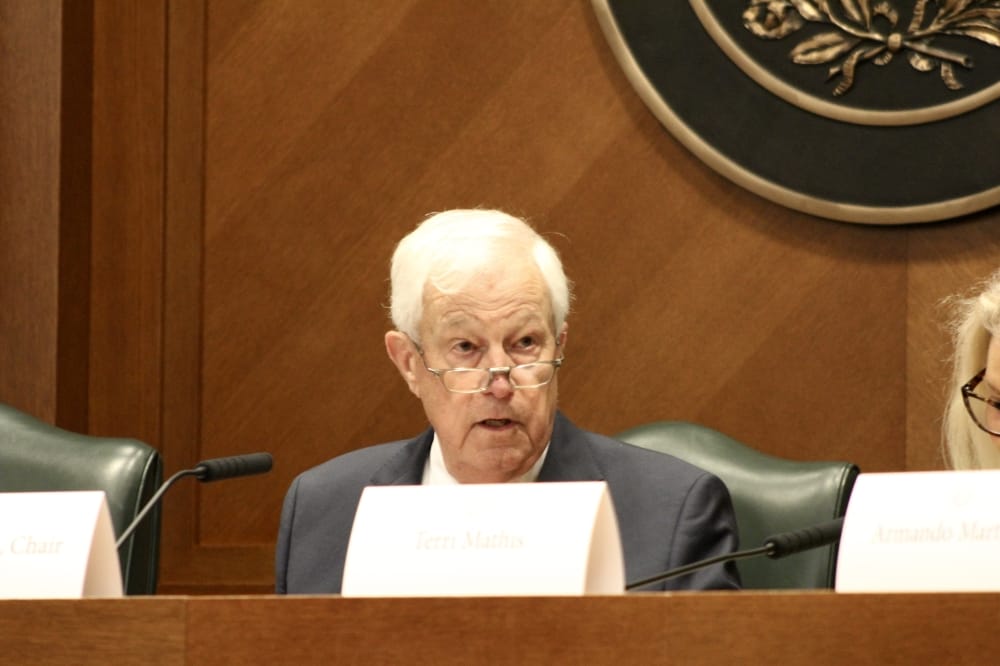
After roughly six hours in a closed-door executive session, the House Administration Committee approved the fines in a brief public session on April 10. The panel’s six Republican members voted in favor of imposing the fines, while the five Democratic members voted against the charges.
Over 50 House Democrats left the state in early August, traveling to Illinois, California, New York and Massachusetts in efforts to fight a plan to redraw Texas’ congressional boundaries. They remained out of Texas for two weeks, impeding the progress of legislation during two special legislative sessions, although the congressional map and more than a dozen other bills ultimately passed after the Democrats returned to Austin.
Some Democrats were charged lower amounts because they did not participate in the full two-week walkout or their absences were partially excused due to personal matters, according to a spreadsheet given to committee members.
How we got here
State lawmakers began their mid-decade redistricting effort last summer at the request of President Donald Trump, who asked Texas and other GOP-led states to redraw their congressional maps to help Republicans maintain a narrow majority in the U.S. House. All states are constitutionally required to redistrict every 10 years, after a census. Mid-decade redistricting is uncommon, but not unprecedented—Texas lawmakers also redrew the state’s congressional boundaries in 2003.
After Republicans unveiled their proposed map in late July, dozens of Democrats held a two-week walkout, decrying the redistricting plan as “racially discriminatory” while Republicans insisted it was drawn for political, not racial, purposes. In the Democrats’ absence, the House did not reach the two-thirds majority, or quorum, needed to pass bills.
House Republicans voted to issue arrest warrants for their quorum-breaking colleagues shortly after they left in early August; however, no members were actually arrested. Gov. Greg Abbott and Attorney General Ken Paxton asked the state Supreme Court to remove at least 13 Democrats from office, arguing the lawmakers had deliberately abandoned their seats in the quorum break. Those cases have since stalled in court.
Under House rules enacted in 2023, members who break quorum can be fined $500 for each day they are absent, plus additional fees for the cost of “securing [their] attendance.” Geren sent letters to the quorum breakers in late August and again in January, informing them that they each owed $9,354.25. That included $7,000 in daily fines and each Democrat’s $2,354.25 share of the nearly $125,000 the state said it spent trying to bring them back to the capitol.
Rep. Charlie Geren, a Fort Worth Republican who chairs the committee, told reporters the committee struck two Sundays when the House was not in session from the final bills, reducing the fines by $1,000. Democrats pushed for other costs reported by the state to be reduced, but those requests were denied.
Geren said letters would be sent to the 52 members detailing the approved fines, but did not specify when payments would be due.
Zooming in
House rules prohibit the use of campaign funds to pay the fines, meaning members are expected to cover the costs themselves. Texas House Democratic Caucus Chair Gene Wu, D-Houston, contested that rule April 10, telling reporters that state law preempts it.
“[House leadership] put that rule in place without thinking it through—state law says any cost of a political process, a political cost of your office, can be reimbursed by campaign [funds],” Wu said. “State law trumps the House rules, period.”
The Texas Election Code states that if an elected official makes a political expenditure out-of-pocket and discloses it under state law, that expense can be reimbursed with campaign funds. Community Impact reached out to Geren’s office and the House Speaker for their comments on this portion of state code, but did not receive a response before press time.
The Texas House Democratic Campaign Committee, the caucus’ fundraising arm, is raising money for incumbent legislators’ reelection campaigns and is not directly involved in paying the fines.
“What [members] choose to do within the bounds of applicable law when the campaign committee makes campaign disbursements is up to them—HDCC is not fundraising to pay the fines and is unable to pay the fines directly on behalf of members,” a spokesperson said.
Going into the quorum break, House Democrats knew the financial costs of interrupting the legislative process, Wu said.
“Some people might have this money, some people might not have this money—but we know what we don’t have: we don’t have the time to wait on this, to sit on this, to not wake up the rest of the country,” Wu said April 7. “We had to do something. If people want to come help us with these costs, … we’re trying to raise money.”
Wu said he will pay his fines out-of-pocket, noting he expects that some of his Democratic colleagues “purely out of principle, will not pay it ever.”
In September, House lawmakers voted to increase penalties for quorum violations, including stripping committee leadership positions, reducing members’ legislative seniority and imposing steeper fines. Those penalties target future quorum breaks and did not apply retroactively.
One more thing
After Texas legislators approved the congressional map in August, several civil rights groups sued the state over the new boundaries. An El Paso federal court blocked the map in November, but its ruling was overturned three days later by the U.S. Supreme Court, which later ruled that Texas could use the new congressional boundaries in this year’s elections.
Republicans currently hold 25 of Texas’ 38 congressional seats. State lawmakers have said the new map will help them gain up to five more seats ahead of the 2027 congressional term, although the true impact of the redistricting effort will not become clear until voters cast their ballots in Texas’ midterm election this November.