


Roughly 76,000 fewer students were enrolled in Texas public schools this academic year than the year prior, according to a report released May 11.
The big picture
Hispanic students accounted for 81% of the enrollment loss in the 2025-26 school year, the public policy nonprofit Texas 2036 found. Enrollment among homeless students, students learning English and students from low-income families declined faster than overall enrollment.
The 2025-26 school year marks the second recorded enrollment drop in recent history, according to Texas Education Agency data collected annually since the 1987-88 academic year. The first decline happened in the 2020-21 school year, at the height of the COVID-19 pandemic.
Analysts warn that public school enrollment will continue to decline in the coming years. Texas 2036 estimated that about 100,000 fewer students would attend Texas public schools by 2030, based on an analysis of enrollment and demographic data from the TEA and the U.S. Census Bureau.
Education demographics expert Bob Templeton told lawmakers May 11 that public school enrollment could fall to about 5 million students in the next four to five years, down from 5.54 million last school year and 5.47 million this year.
“This is not another blip or a one-off,” Templeton said during a Texas House Public Education Committee hearing. “This is an inflection point, and it is the start of sustained enrollment decline.”
Meanwhile, school districts across Community Impact’s coverage areas are in the process of closing and consolidating campuses, citing enrollment declines and budget shortfalls. Statewide, at least 130 individual campuses have been selected for closure in the past two years, according to the public education advocacy group Our Schools Our Democracy.
“It is happening all over this state, … and I think that we need a plan [to address] that, because it’s not a local issue,” state Rep. Gina Hinojosa, an Austin Democrat who is running for governor, said May 11.
Zooming in
Since 1987, Texas public school enrollment has generally grown by about 1%-3% each year, Texas 2036 found. Enrollment dipped by 2.2% in the 2020-21 school year, then began rising again before a 1.4% drop in the 2025-26 school year, the data shows.
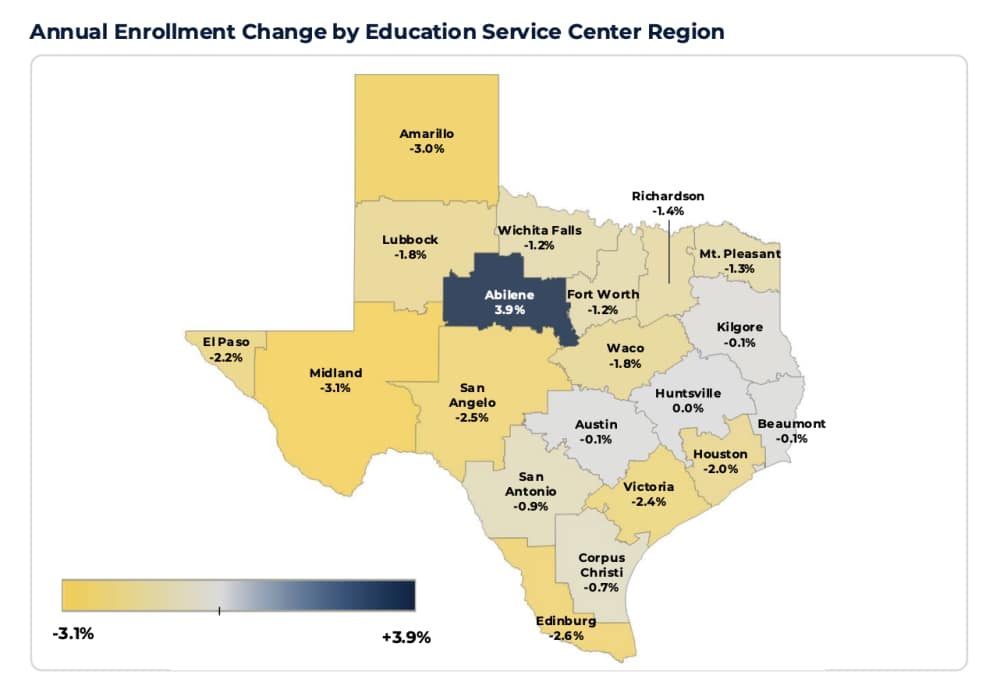
Enrollment declined the most in the Panhandle, West Texas and near the Texas-Mexico border, Texas 2036 reported. Only the Abilene region saw an increase in enrollment this school year, while enrollment in some Central and East Texas regions did not change significantly.
Large urban schools and districts in nearby suburbs have also seen steady declines, according to the report, with the largest urban districts losing nearly 170,000 students in the past decade. School districts in smaller cities, towns and rural communities have grown in the same period.
“What stands out in the data is that public school enrollment is falling even as Texas continues to grow,” Carlo Castillo, a senior research analyst with Texas 2036, said in a May 11 statement. “In many parts of the state, population gains are no longer translating into public school enrollment growth. That points to a broader structural shift policymakers and district leaders will need to plan for.”
School districts across Texas have recorded enrollment declines for years as more families pursue education options such as charter schools, private schools and homeschooling, according to previous Community Impact reporting. Declining birth rates have also contributed to the enrollment loss.
Of the 76,613-student decline in enrollment between the 2024-25 and 2025-26 school years, 61,781 were Hispanic students, per TEA data. Enrollment among Black and white students also declined, while Asian enrollment increased.
TEA Commissioner Mike Morath addressed the enrollment decline during a May 11 presentation to lawmakers, although he said he could not explain why it happened.
“This year, we are down students, and these [drops] are somewhat more accelerated than statewide demographic trends indicated,” Morath said. “We cannot tell you the precise cause of this. We just know that it has occurred.”
Morath said large enrollment declines mean that districts will lose revenue, “even with increased resources from the legislature.”
“Significant enrollment loss tends to eventually lead to campus closure,” Morath, a former Dallas ISD trustee who has led the TEA for a decade, said May 11. “As a former school board member that had to navigate campus closures before, those are very difficult decisions that have to be made to preserve the financial integrity of the school, to make sure there’s sufficient resources that can be provided to the remaining students.”
Lawmakers and policy experts said May 11 that the state should study why enrollment is declining and consider adjusting its education policies in response.
“The policy question for Texas is no longer whether public school enrollment will decline, but how the state will adapt to a public school system that is smaller and structurally different than the one most current policies were designed around,” the Texas 2036 report reads.
One more thing
The enrollment data does not include students who may withdraw from their public school districts ahead of the 2026-27 school year to participate in Texas’ education savings account program. Under the $1 billion program, participating families will receive state funds to spend on private education or homeschooling.
More than 274,000 students applied for the first year of the Texas Education Freedom Accounts program, and nearly 96,000 students were invited to participate, Community Impact reported. State data shows that at least 43% of approved students previously attended a Texas public school, although it is unclear how many of those students will ultimately enroll in the program this fall.
Invited families have until July 15 to confirm enrollment at a private school involved in the program, notify the state that they will homeschool their participating children or opt out of the program, according to the Texas comptroller’s office.
During a March 25 event hosted by the Urban Land Institute Austin, some Austin-area school district leaders said they did not anticipate that the TEFA program would cause public school enrollment to decline significantly in the 2026-27 school year.
“I think most of us are not worried about our students having a mass exodus out of our school district, but we do need to do a better job in talking about why [a public school district] is the best choice for you,” Austin ISD chief financial officer Katrina Montgomery said March 25.